Open 24/7 · Same-day mindset · 24/7 emergency
San Antonio North Side
210-699-7159
You heard a bang, the door won’t budge, and every forum gives different advice. This guide covers the safe next steps, real San Antonio costs, and when it’s time to call for same-day service.
You heard a bang like a gunshot in the garage. Now the door won’t budge, or it lifts four inches and stops dead. That’s a broken spring, and the next ten minutes matter. Springs carry the entire weight of the door — what you’re dealing with is not a mechanical annoyance but a high-tension failure that can damage your opener, your door, or you.
This guide walks through exactly what to do first, what the repair actually costs in the San Antonio market, how long springs really last, and how to pick a company that quotes before it works. Summit Garage Doors Inc replaces springs across the North Side every week, and most of what you’ll read below is what our techs explain on-site — written down.
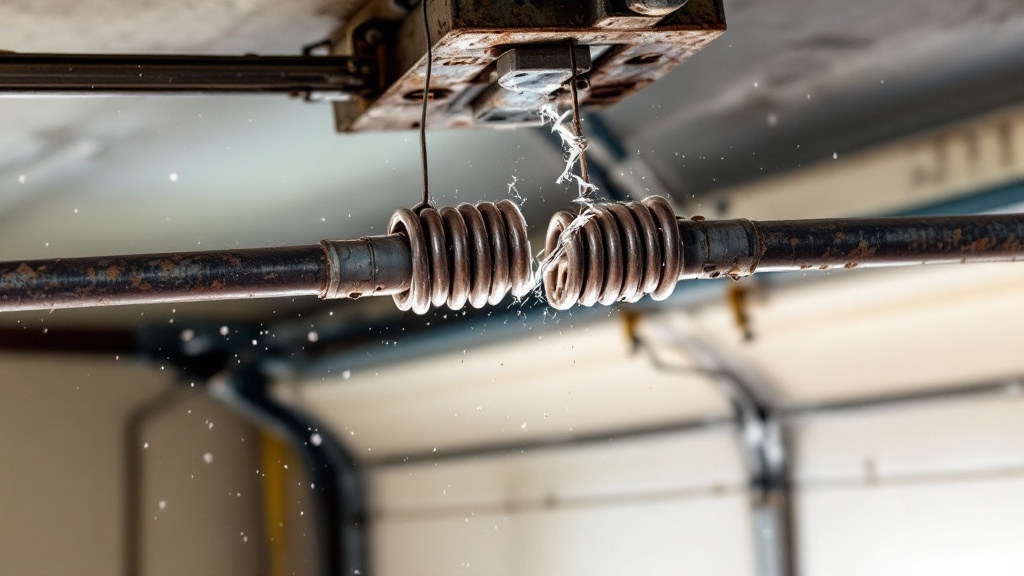
The snap itself is usually the first clue — a loud bang from the garage, often audible inside the house, sometimes mistaken for someone dropping something heavy. After that, the symptoms stack up fast:
A healthy torsion spring is one continuous coil. If you see daylight between two sections of the coil, it snapped. That inspection takes ten seconds and requires no tools — stand outside the door’s path and look up.
No — and this is the point most people get wrong. The springs, not the opener, carry the door’s weight. The opener motor is roughly a half-horsepower unit designed to guide a balanced door, not lift a quarter-ton of steel. With a broken spring, nothing is holding that weight but the cables and your hands.
If you absolutely must get a vehicle out and the door is already partly open, prop it with two 2x4s cut to length on both sides before anyone walks underneath. Better: wait. A pro with the right tools can usually free a trapped car in under an hour.
Call immediately if the door is stuck open — your home is unsecured. Same if a vehicle is trapped and you need it, or if the door is hanging crooked in the track. A lopsided door can jump the track entirely, which turns a $300 spring job into a $1,200 door and track repair.
Running the opener against a broken spring strips the plastic drive gear and burns out the motor. That’s how a $250 spring problem becomes an $800 opener replacement. We see it several times a month.
Metal fatigue does most of the work. Every open-and-close cycle flexes the steel a little, and the coil eventually gives up. Spring failure isn’t bad luck — it’s scheduled. A standard spring is rated for 10,000 cycles, and when you hit that number, it breaks.
This is where San Antonio differs from Phoenix or Denver. Gulf-influenced humidity puts moisture on bare steel year-round, and rust between coils increases friction on every cycle. Add the temperature swing — a 105°F garage in August, a 38°F morning in January — and steel that’s already fatigued contracts and snaps. That’s why so many local springs fail during the first real cold snap of the season.
Builder-grade springs on new construction are commonly the cheapest 10,000-cycle units available, chosen to hit a price point. Worse is undersizing: an insulated steel or solid wood door can weigh 350+ lbs, and a spring specced for a lighter door will fail dramatically early — sometimes within two or three years.
Mount horizontally on a steel shaft directly above the door opening. They twist (torque) to lift the door. Look up and see one or two long springs on a bar spanning the header.
Run parallel to the horizontal tracks, one along each side, stretching and contracting as the door moves. Long springs on the sides near the ceiling mean extension.
Torsion, on every metric that isn’t upfront price: better balance, longer service life, quieter, and a much safer failure mode. It’s the modern standard.
| Comparison | Torsion | Extension |
|---|---|---|
| Mounting | Shaft above door | Alongside horizontal tracks |
| Typical lifespan | 10,000–20,000 cycles | 8,000–10,000 cycles |
| Failure mode | Stays on the shaft | Can become a projectile without safety cables |
| Cost (pair, installed) | $300–$500 | $150–$250 |
| Heavy doors | Yes | Light/single doors only |
Extension springs are cheaper, and they’re fine on a light single-car door if the safety cables are intact. Those cables run through the center of each spring and catch it if it breaks. If your extension springs don’t have safety cables, get them added — it’s an inexpensive fix for the worst-case scenario in this trade. Converting from extension to torsion typically runs $250–$500 including the shaft, drums, cables, brackets, and springs.
The short answer: most San Antonio homeowners pay $200–$350 for a single torsion spring installed, and $300–$500 for a pair. Extension springs run $150–$250 for a pair installed.
| Door | Springs | Installed cost |
|---|---|---|
| Single-car (8×7) | 1 torsion | $180–$300 |
| Standard double-car (16×7) | 2 torsion | $300–$450 |
| Insulated double-car | 2 torsion | $350–$550 |
| Heavy wood / custom | 2 heavy-gauge | $450–$750 |
| Line item | Typical range |
|---|---|
| Torsion spring (part only) | $40–$100 each |
| Labor | $85–$175 |
| Service call fee | $50–$100 (often waived with repair) |
| Center bearing | $15–$40 |
| Emergency / after-hours / weekend | +$50–$150 |
For two springs on a standard double door, parts and labor included, $300–$500 is the honest range in this market. Under $150 is either a bait quote that grows on site, or genuinely low-grade springs. Over $700 on a standard steel double door deserves a second opinion — unless the quote includes drums, cables, bearings, and high-cycle springs. This is exactly why Summit quotes a flat, all-in price in writing before any work starts.
Both springs on a two-spring door were installed the same day and have shared the load on every cycle since. They have effectively identical wear. When one breaks, the other is typically weeks to a few months from the same fate.
The math is straightforward: replacing both during one visit adds only the part — roughly $40–$100 — because you’re not paying a second service call and a second labor charge. Replacing them separately means paying $200–$350 twice. Doing both is usually 30–40% cheaper over 12 months.
There’s a mechanical argument too: a new spring paired with a worn one pulls unevenly. That imbalance racks the door in the tracks and grinds on rollers, hinges, and the opener. The one legitimate exception is a spring genuinely replaced within the last year alongside an older one — a good tech will check the date and agree with you.

A wound torsion spring holds hundreds of pounds of stored torque. Release it wrong and the winding bar becomes a projectile — through the drywall if you’re lucky, through your forearm or face if you aren’t. The U.S. Consumer Product Safety Commission logs thousands of garage door injuries annually, and spring work accounts for a disproportionate share of the serious ones.
Plenty of garage door work is reasonable DIY — replacing rollers, tightening hardware, adjusting the photo eyes. Springs are the one repair where the math is genuinely lopsided.
One cycle = one full open plus one full close. Standard springs are rated 10,000 cycles:
| Daily cycles | Expected lifespan |
|---|---|
| 2 cycles/day | ~14 years |
| 4 cycles/day | ~7 years |
| 6 cycles/day | 4–5 years |
| 8 cycles/day | 3–4 years |
Most households average 3–5 cycles a day, which puts real-world lifespan at 7–12 years. But if your garage is the family’s main entrance — kids, two commuters, a teen driver — you can hit 8–10 cycles daily and burn through a standard spring in under four years.
High-cycle springs rated 20,000–50,000 cycles cost roughly $50–$150 more per spring and often double or triple service life. If you’re already paying for the visit, the labor, and the trip charge, ask for high-cycle by name. Summit stocks them on every truck.

The technician secures the door, then measures wire gauge, inside diameter, and overall length to spec the exact replacement — no guessing from a truck inventory. The old spring is unwound under control with winding bars, hardware is swapped, and the new spring is wound to the precise turn count for your door height.
While the door is down, a good tech inspects the parts that wear on the same clock: center and end bearings, lift cables, cable drums, and rollers. These are inexpensive to replace concurrently and expensive to come back for. The job ends with a balance check, a force and auto-reversal safety test on the opener, and lubrication — balanced and tested before we leave.
Time: 45–90 minutes for a standard double-car door. Nearly all San Antonio spring calls are single-visit.
Lubricate every six months. Use a garage door-specific lithium or silicone spray on springs, hinges, rollers, and bearings. Never use WD-40 — it’s a solvent and degreaser, and it strips the lubricant you need while leaving residue that attracts grit. In San Antonio’s humidity, that lubricant film is doing double duty as a corrosion barrier.
Minimum 1 year on parts and labor. High-cycle springs should carry 3–7 years. Get it in writing on the invoice. A company that can’t explain the cycle-count reasoning behind its recommendation is telling you something — listen. If you’re comparing options, our guide to garage door spring replacement covers what the service itself should include.
Expect $300–$500 for a pair of torsion springs installed, including parts, labor, and the service call. Extension springs run $150–$250 per pair. Insulated or heavy wood doors need heavier springs and land at $450–$750. Anything quoted under $150 is either low-grade steel or a bait price.
You shouldn’t. The springs carry the door’s weight, so with one broken the door weighs 150–250 lbs unsupported. Running the opener will strip the drive gear and can burn out the motor, turning a spring repair into an opener replacement. Park outside and call a technician.
45 to 90 minutes for a standard double-car door, including measurement, replacement, balancing, and safety testing. Most San Antonio calls are finished in one visit.
Yes, in nearly every case. Both springs have the same cycle count, so the surviving one is usually weeks to months from failing. Doing both during one visit adds only the $40–$100 part cost instead of a second full service call. The exception is a spring genuinely installed within the last year.
Standard springs are rated for 10,000 cycles — one open plus one close. At 3–5 cycles a day, that’s 7–12 years. Heavy users hitting 8 cycles daily see 3–4 years. High-cycle springs rated 20,000–50,000 cycles cost $50–$150 more each and often double or triple that lifespan.
If the door won’t close and secure the home, or a vehicle is trapped that you need, yes — call 210-699-7159. If the door is simply down and the garage is closed, it can usually wait for the next same-day slot without any risk of further damage.

Summit Garage Doors Inc is an independent San Antonio shop on Blanco Road. We fix garage doors for North Side neighbors — Stone Oak, Timberwood, the Blanco Road corridor and beyond. Torsion and extension springs on every truck, written all-in pricing before work starts, and a balance and safety test before we leave.
We keep same-day openings when the board allows. Either way: diagnosis first, written price second, then the fix.